Khu Ioduan App
Apr. 25th, 2018 01:47 am![[personal profile]](https://www.dreamwidth.org/img/silk/identity/user.png) makebelieveavenger
makebelieveavenger♠ Player Information ♡
♢ Character Information ♣
♘ Writing Sample ♛
[Network - Video]
[A bright, green eye fills the screen for a moment before a young woman pulls back from the lens. She looks a several meals and a few nights sleep short of healthy, and she's decidedly disheveled. Her grey clothes, stained with soot look rather old fashioned as well.]
----this how it works? Ah, quite. I see the little light.
How remarkable - and no smelly chemicals? ...Papa would have been over the moon about this.
[There is a slight hint of regret or sadness in her tone at this, but she seems to settle, and the view from the camera steadies. She at least seems somewhat familiar with the concept of photography.]
The nice... ...er...
[She glances to the side of her at the Kin'nal who helped her, but he's already wandered off, clearly done with her many, many questions. She carries on, regardless.]
The nice lizard said that this is the best way to speak with other Dreamfolk. Isn't that a peculiar thing? We are Dreamfolk, but this isn't a dream. Or so he says. How would you even test if something's a dream or not if you're in the dream - a pinch would hardly do - you could just be dreaming the pain like anything else.
The cat hasn't shown up with any of his cryptic nonsense though, so perhaps that's a good sign.
I find it hard to imagine there are people on the other side of this camera, but that is what I was told. It sounds like a rather elaborate ruse, but I am a Dreamfolk outside of a dream - perhaps common sense is also hung out to dry. Meeting others has... never really been my forte, but it couldn't hurt to try.
My name is Alice. Alice Liddell.
APP | PERMISSIONS | IC CONTACT | NAVIGATION
Name: Green Rivers
Age/18+?: 33 in August
Contact:![[plurk.com profile]](https://plurk.com/favicon.ico) GreenRivers or GreenRivers4204 on discord
GreenRivers or GreenRivers4204 on discord
Other Characters Played: Klaus Von Reinherz
Most Recent AC Link: Here
Age/18+?: 33 in August
Contact:
Other Characters Played: Klaus Von Reinherz
Most Recent AC Link: Here
♢ Character Information ♣
Name: Alice Liddell
Canon: American Mcgee’s Alice series
Canon Point: After Madness returns and shortly before Outlands, when she’s gotten a job at the Royal Opera House
Age: 20
Type of Character: Canon
Reference:
I’d first like to preface this with a content warning; the first two games deal with some pretty dark subject matter (the second game in particular) - this includes the general shitty treatment of inmates in 19th century asylums, self harm, suicide, murder, physical, emotional and sexual abuse, sex trafficking of children etc. So basically, CW: Everything Under the Sun. Where these things come up in the app proper, I'll be highlighting them in red. Any headcanon will be highlighted as bold
Alice Liddel - Wiki
Personality:
I’d like to clear up one of the more common misconceptions about this version of Alice’s personality which came about from EA's grossly misleading advertising: she is not a homicidal, revenge-driven psychopath with zero empathy. She doesn't go around stabbing innocent bystanders in the face. Nor is she an 'anti hero' as most of her motives and methods remain ostensibly in the 'heroic' category.
What Alice is, however, is a traumatized young woman who has been trying to make sense of her internal pain and the suffering of those around her. Most of the violence in the story takes place entirely within the confines of her mind, being more a representation of her personal struggles than anything literal. Only three times has Alice acted violently in the real world, and only once was it a conscious attack.
Alice lost her family to fire when she was only about eight years old and this has haunted her for most of her life. For years she believed that she may have been responsible for the deaths of her beloved parents and older sister. The trauma and sense of guilt left her catatonic, and she was committed to Rutledge Asylum for nearly a decade. The treatments she underwent (supervised by the well-meaning albeit, by our standards today, ignorant Doctor Wilson) probably had little to do with her recovery, and even after leaving his care, her survivor's guilt continued to haunt her. This left Alice a melancholy and withdrawn individual without family and very few friends.
Alice is not the most sociable person - she is decidedly withdrawn and slow to trust - but she's not consumed with apathy, nor is she timid. She's retained her deeply curious nature of her childhood, and has a habit of sticking her nose where it may not necessarily belong. Especially if things she's observed don't add up to what she's been told. This is particularly true with regards to the fire. Despite her fears that she may very well have had a hand in her family's deaths, she still pursued perceived anomalies with a dogged tenacity.
She is also not particularly reserved about speaking up, even to authority figures. When she perceives an injustice, she is immediately vocal with her outrage. Both in the real world and within the mindscape of Wonderland, she tends to confront problems head-long, though her real-world confrontations don't always end quite so much in her favour. Even so, she's not afraid to stand up for herself or others, such as the numerous times she confronted the pimp Jack Splatter, or Doctor Bumby.
As mentioned before, Alice is not actually a violent person. She can come across as cold and detached, but she can be profoundly sympathetic to others in pain and she's willing to take action on their behalf with little regard to her own well-being. She isn't entirely selfless, ( the case files of the first game indicate she has self-harming, possibly suicidal tendencies and has little regard for her own well-being), but most of her actions come from a want to help others. Doctor Wilson describes her as having a 'hero complex'.
One of Alice's biggest problems is her inability to deal with her real-world issues. She tends to lose herself in the fantastical and this blinds her to the things around her. Both the Jabberwock and the Caterpillar have remarked on this, though the Jabberwock's goal was to paralyze her with guilt and stop her from taking action, while Caterpillar's was to get her to process and face the her problems both internal and external.
___________________
Alice: I've come all this way to find a simulacrum?!
Caterpillar: If I had the time, I'd detail how often you prefer dealing with illusions rather than the real thing. Problems you refuse to deal with don't exist! You deny reality!
Alice: That's not right! I know what's real!
Caterpillar: No! You allow others to tell you what isn't real.
___________________
Because of this, it took Alice a long time to realize that her psychiatrist, Doctor Angus Bumby, was the man who stalked and raped her sister, murdered her family, was hypnotizing children into becoming sex slaves that he sold to pimps, and had every intention of doing the same to Alice through his "treatments". As far as she was concerned, her ignorance was as good as complacency, and she immediately confronted him at Moorgate Station. When he made it evident that her testimony would count for little and that it was almost guaranteed that he'd not only get away with his crimes, but continue committing them, she shoved him in front of an oncoming train.
Despite being in and about twenty years old, Alice is a bit stunted. No surprise really, since she's had a decade of her life stolen from her. So for the past year or so, she's been playing a harried game of catch-up, in a state of poverty with few friends and dealing with the stigma of mental illness in the slums 19th century London. It's not been an easy road, but she's made significant progress reintegrating into society. She still sometimes has the mannerisms of a petulant child and her sense of morality can be somewhat black and white. She also remains deeply attached to the paraphernalia of her childhood, and toys, games, talking animals, and a sort of whimsical logic occupy her thoughts and hallucinations. Regardless, Alice's story is one of personal growth, and discovering the truth and dispatching her family's killer has given her a sense of closure, leaving things a bit more hopeful for her.
Appearance: The term ‘consumptive chic’ comes to mind - Alice is thin, sickly pale, and dressed in dull, raggedy hand-me-downs - though she's still rather pretty, with dark hair and vivid green eyes. She's the very picture of your prototypical tragic, Victorian heroine, of the riches to rags variety. She's on the disheveled side and the dark circles around her eyes give the impression she's not getting the sleep she needs, and her bony stature suggests she can't afford much as food goes either.
Her Wonderland counterpart is a bit of a contrast, with a healthy complexion and an array of lovely dresses (though she favours the classic navy blue with the white apron), and a more assertive posture. She's never without a pendant in the shape of Ω, and she seems rather fond of black and white striped stockings and a pair of sensible leather boots. Her apron pockets are always marked with alchemical symbols that correspond to Roman gods and usually stand for whatever stage of her journey she's in. The blue dress is marked by the symbol for Eris, goddess of strife and discord, and Jupiter, a symbol of mind over matter.
Real World | Wonderland Persona (Classic) | DLC Fursona
Abilities:
Alice has an extraordinary imagination, but outside her thoughts and dreams, she is physically a normal young woman. She has some talent for playing the piano, and is artistically inclined, but years of being comatose has left little opportunity for her to refine these talents.
However, Alice: Otherlands has made the possibly supernatural elements of the first two games much less ambiguous. In the two animated shorts and the artbook, she has gained the ability to actually enter people's minds in a space called the Otherlands, described as a place where dreams and reality collide. Effectively she can traverse other people's 'Wonderlands'.
Whether this is entirely in her head or something she can actually do (and maybe another nod to Psychonauts) is debatable. How she got these abilities or where they come from is not really touched on. Some theories include that she's always had them, as even within Rutledge she was a peculiar case and strange things were always happening around her. Others have suggested Bumby's hypnotism may have awoken some latent psychic abilities in Alice but I'm loathe to attribute anything positive to that scumbag. The closest we have to a definitive answer is from the wiki: "American McGee viewed Wonderland as a manifestation of Alice's supernatural power of the mind. Not a dream, not illusion, but a reality created (and destroyed) by imagination, the only limits of which were Alice's fears and hopes". Which doesn't really answer anything.
As it is, they're more of a plot device to get in the heads of some famous historical figures, and I'm pulling her from just before the first Otherlands short; Leviathan, so she won't have them when she arrives.
However, how they're explored in the shorts as a means of philosophizing and exploring other people's mental and emotional conflicts and helping them work through them is incredibly appealing from a player standpoint, and something I'd love to incorporate in Khu. I'd love to have these abilities gradually develop throughout the course of her stay in Aifaran as Alice gains a stronger sense of herself and the world around her.
Besides that, Alice is ripe for Dreaming fuckery, and her "dream" self has all kinds of nifty abilities and fun toys. None of these powers or items can be used outside a dreamscape. However, with how the Dreaming works in Konryu, it may be possible for them to gradually bleed over into reality as Alice grows as a character. If this is feasible, I'd love to do some kind of event where other characters encounter the objects that temporarily bestow abilities or the many creative weapons (though that's food for thought later).
Edit: For clarity, Alice won’t have access to any of these weapons or powers upon arrival. I intend to have her gradually earn them through item and ability requests throughout her time in game. They’re just listed for completion’s sake.
Suitability: Alice so neatly embodies the blurring of dreams with reality - especially this particular interpretation of her character. She would work very well in a world where a force like the Dreaming is so essential to the plot. With her coming in blind to her abilities, there is a lot of opportunity for her to grow into someone closer to how she idealizes herself and her values.
Inventory: The clothes on her back, the key to Lizzie's room she swiped off Bumby before she pushed him in front of a train, and a tuppence in her pocket.
Talent Preferences: Illusion, Alteration, Conjuration
Canon: American Mcgee’s Alice series
Canon Point: After Madness returns and shortly before Outlands, when she’s gotten a job at the Royal Opera House
Age: 20
Type of Character: Canon
Reference:
I’d first like to preface this with a content warning; the first two games deal with some pretty dark subject matter (the second game in particular) - this includes the general shitty treatment of inmates in 19th century asylums, self harm, suicide, murder, physical, emotional and sexual abuse, sex trafficking of children etc. So basically, CW: Everything Under the Sun. Where these things come up in the app proper, I'll be highlighting them in red. Any headcanon will be highlighted as bold
Alice Liddel - Wiki
Personality:
I’d like to clear up one of the more common misconceptions about this version of Alice’s personality which came about from EA's grossly misleading advertising: she is not a homicidal, revenge-driven psychopath with zero empathy. She doesn't go around stabbing innocent bystanders in the face. Nor is she an 'anti hero' as most of her motives and methods remain ostensibly in the 'heroic' category.
What Alice is, however, is a traumatized young woman who has been trying to make sense of her internal pain and the suffering of those around her. Most of the violence in the story takes place entirely within the confines of her mind, being more a representation of her personal struggles than anything literal. Only three times has Alice acted violently in the real world, and only once was it a conscious attack.
Alice lost her family to fire when she was only about eight years old and this has haunted her for most of her life. For years she believed that she may have been responsible for the deaths of her beloved parents and older sister. The trauma and sense of guilt left her catatonic, and she was committed to Rutledge Asylum for nearly a decade. The treatments she underwent (supervised by the well-meaning albeit, by our standards today, ignorant Doctor Wilson) probably had little to do with her recovery, and even after leaving his care, her survivor's guilt continued to haunt her. This left Alice a melancholy and withdrawn individual without family and very few friends.
Alice is not the most sociable person - she is decidedly withdrawn and slow to trust - but she's not consumed with apathy, nor is she timid. She's retained her deeply curious nature of her childhood, and has a habit of sticking her nose where it may not necessarily belong. Especially if things she's observed don't add up to what she's been told. This is particularly true with regards to the fire. Despite her fears that she may very well have had a hand in her family's deaths, she still pursued perceived anomalies with a dogged tenacity.
She is also not particularly reserved about speaking up, even to authority figures. When she perceives an injustice, she is immediately vocal with her outrage. Both in the real world and within the mindscape of Wonderland, she tends to confront problems head-long, though her real-world confrontations don't always end quite so much in her favour. Even so, she's not afraid to stand up for herself or others, such as the numerous times she confronted the pimp Jack Splatter, or Doctor Bumby.
As mentioned before, Alice is not actually a violent person. She can come across as cold and detached, but she can be profoundly sympathetic to others in pain and she's willing to take action on their behalf with little regard to her own well-being. She isn't entirely selfless, ( the case files of the first game indicate she has self-harming, possibly suicidal tendencies and has little regard for her own well-being), but most of her actions come from a want to help others. Doctor Wilson describes her as having a 'hero complex'.
One of Alice's biggest problems is her inability to deal with her real-world issues. She tends to lose herself in the fantastical and this blinds her to the things around her. Both the Jabberwock and the Caterpillar have remarked on this, though the Jabberwock's goal was to paralyze her with guilt and stop her from taking action, while Caterpillar's was to get her to process and face the her problems both internal and external.
Alice: I've come all this way to find a simulacrum?!
Caterpillar: If I had the time, I'd detail how often you prefer dealing with illusions rather than the real thing. Problems you refuse to deal with don't exist! You deny reality!
Alice: That's not right! I know what's real!
Caterpillar: No! You allow others to tell you what isn't real.
___________________
Because of this, it took Alice a long time to realize that her psychiatrist, Doctor Angus Bumby, was the man who stalked and raped her sister, murdered her family, was hypnotizing children into becoming sex slaves that he sold to pimps, and had every intention of doing the same to Alice through his "treatments". As far as she was concerned, her ignorance was as good as complacency, and she immediately confronted him at Moorgate Station. When he made it evident that her testimony would count for little and that it was almost guaranteed that he'd not only get away with his crimes, but continue committing them, she shoved him in front of an oncoming train.
Despite being in and about twenty years old, Alice is a bit stunted. No surprise really, since she's had a decade of her life stolen from her. So for the past year or so, she's been playing a harried game of catch-up, in a state of poverty with few friends and dealing with the stigma of mental illness in the slums 19th century London. It's not been an easy road, but she's made significant progress reintegrating into society. She still sometimes has the mannerisms of a petulant child and her sense of morality can be somewhat black and white. She also remains deeply attached to the paraphernalia of her childhood, and toys, games, talking animals, and a sort of whimsical logic occupy her thoughts and hallucinations. Regardless, Alice's story is one of personal growth, and discovering the truth and dispatching her family's killer has given her a sense of closure, leaving things a bit more hopeful for her.
Appearance: The term ‘consumptive chic’ comes to mind - Alice is thin, sickly pale, and dressed in dull, raggedy hand-me-downs - though she's still rather pretty, with dark hair and vivid green eyes. She's the very picture of your prototypical tragic, Victorian heroine, of the riches to rags variety. She's on the disheveled side and the dark circles around her eyes give the impression she's not getting the sleep she needs, and her bony stature suggests she can't afford much as food goes either.
Her Wonderland counterpart is a bit of a contrast, with a healthy complexion and an array of lovely dresses (though she favours the classic navy blue with the white apron), and a more assertive posture. She's never without a pendant in the shape of Ω, and she seems rather fond of black and white striped stockings and a pair of sensible leather boots. Her apron pockets are always marked with alchemical symbols that correspond to Roman gods and usually stand for whatever stage of her journey she's in. The blue dress is marked by the symbol for Eris, goddess of strife and discord, and Jupiter, a symbol of mind over matter.


Abilities:
Alice has an extraordinary imagination, but outside her thoughts and dreams, she is physically a normal young woman. She has some talent for playing the piano, and is artistically inclined, but years of being comatose has left little opportunity for her to refine these talents.
However, Alice: Otherlands has made the possibly supernatural elements of the first two games much less ambiguous. In the two animated shorts and the artbook, she has gained the ability to actually enter people's minds in a space called the Otherlands, described as a place where dreams and reality collide. Effectively she can traverse other people's 'Wonderlands'.
Whether this is entirely in her head or something she can actually do (and maybe another nod to Psychonauts) is debatable. How she got these abilities or where they come from is not really touched on. Some theories include that she's always had them, as even within Rutledge she was a peculiar case and strange things were always happening around her. Others have suggested Bumby's hypnotism may have awoken some latent psychic abilities in Alice but I'm loathe to attribute anything positive to that scumbag. The closest we have to a definitive answer is from the wiki: "American McGee viewed Wonderland as a manifestation of Alice's supernatural power of the mind. Not a dream, not illusion, but a reality created (and destroyed) by imagination, the only limits of which were Alice's fears and hopes". Which doesn't really answer anything.
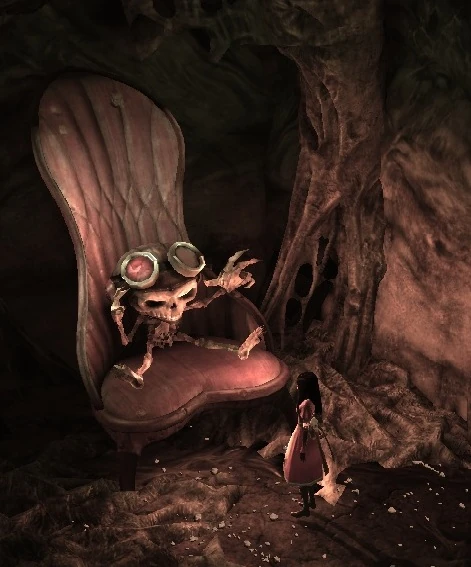
As it is, they're more of a plot device to get in the heads of some famous historical figures, and I'm pulling her from just before the first Otherlands short; Leviathan, so she won't have them when she arrives.
However, how they're explored in the shorts as a means of philosophizing and exploring other people's mental and emotional conflicts and helping them work through them is incredibly appealing from a player standpoint, and something I'd love to incorporate in Khu. I'd love to have these abilities gradually develop throughout the course of her stay in Aifaran as Alice gains a stronger sense of herself and the world around her.
Besides that, Alice is ripe for Dreaming fuckery, and her "dream" self has all kinds of nifty abilities and fun toys. None of these powers or items can be used outside a dreamscape. However, with how the Dreaming works in Konryu, it may be possible for them to gradually bleed over into reality as Alice grows as a character. If this is feasible, I'd love to do some kind of event where other characters encounter the objects that temporarily bestow abilities or the many creative weapons (though that's food for thought later).
Edit: For clarity, Alice won’t have access to any of these weapons or powers upon arrival. I intend to have her gradually earn them through item and ability requests throughout her time in game. They’re just listed for completion’s sake.
- Wonderland Powers
- Rage Box
"How fine you look when dressed in rage. Your enemies are fortunate your condition is not permanent. And you're lucky too; red eyes suit so few."
A red, crystalline container that sprays Alice with a red substance and turns her quite devilish. Alice gains extra strength and invincibility for a short time. In Madness Returns, the Rage Box is replaced with Hysteria. - Grasshopper Tea
"Those who say, 'There's nothing like a nice cup of tea for calming the nerves', never had real tea. It's like a syringe of adrenaline straight to the heart."
Grasshopper Tea comes in a Grasshopper Teapot, and when Alice drinks it, it gives her a rather insect-like appearance and lets her jump much higher and faster. This has become obselete by the time of Madness Returns, as by then, Dream Alice can execute a triple jump. - Looking Glass
"Noisy creatures, crooks and assorted voyeurs would love to be invisible. For you, the option may be a matter of survival."
A very rare item that, when Alice looks in it, will turn her temporarily invisible before it vanishes. - Float
"When the path is problematical, consider a leap of faith. Ride the wind!"
In both games, Alice makes use of air vents to propel herself in the air. In the second game, she can also use her skirt like a parachute to soften her falls whenever she gets airborne, not just from vents. - Butterfly Dodge
"Observe, learn, and react!"
In Madness Returns, Alice has a dodge ability where she explodes into a swarm of butterflies and reforms into herself a few yards away. It's as pretty as it sounds. - Shrinking Violet/ Shrink Sense
"The upside is that you can see things that are nearly invisible to your bigger self."
After taking a plunge in a pool of shrinking potion, Alice is able to shrink down to the size of a doll at will. In this state she can see things that are invisible, take refuge in violets that heal her, and, of course, navigate the narrow passageways she couldn't otherwise. - Triple Jump
"Experience teaches best. I suppose 'Learn by doing' and similar cliches have merit. Take their advice, I'm busy."
Why have a double jump when you can have a triple jump? - Hysteria
"What lies beneath this patina of civility? Something wicked I'd wager."
Virtually identical to the Rage Box, the only difference between that and Hysteria is that Alice gains the abilities when she's low on health. And it just looks cooler._______________
Wonderland Weapons
The weapons from the first game drain Willpower, the weapons from the second have other limitations. - The Vorpal Blade
"The Vorpal Blade is swift and keen and always ready for service."
Alice's default weapon of choice, the Vorpal Blade is an ornate carving knife that's quite effective at slicing and dicing. It's the only one that has been consistent throughout the series and she is very rarely without it. Used both as a close range weapon, or thrown at a target, the Vorpal Blade always returns to Alice's hand. - Playing Cards
"52 pickup is a staple of juvenile humor. But when the deck slices and dices, it's no laughing matter."
Responsible for one of my favourite idle animations in all of video games, the weapon itself however is fairly straightforward. Alice throws playing cards as razor sharp as some of her witty retorts. Drains a little will at a time. - Croquet Mallet
"Here's a riddle. When is a croquet mallet like a billy club? I'll tell you: whenever you want it to be."
The Croquet Mallet (shaped like a flamingo) has two attacks. One where you bludgeon enemies with an electrical shock and a second where you bat around an electrified croquet ball which bounces off walls. Drains a little will, but the attacks are only moderately powerful. - Jackbomb
"Jack's a friend, but his temperament is explosive, maybe best to let him play by himself."
The Jackbomb has two different attacks - one where it can be placed and after a short period, explode. The other involves it spinning around and spitting fire. Replaced by the Clockwork Rabbit bomb in Madness Returns. Drains a moderate amount of Will. - Ice Wand
"Withering cold incapacitates an enemy more completely than deep wounds, but Winter does not last forever."
A magic wand that can create a wall of ice to protect Alice, or blast her foes with icy winds, freezing them in place. Drains a moderate amount of will. - Jacks
"This simple game can turn distinctly nasty. Don't ever play alone."
The jacks can do scatter damage on a group of foes, or targeted damage on a single foe. Either way, something is getting cut to ribbons and hopefully it's not Alice. Costs a small-moderate amount of will. - Demon Dice
"Ahh... The Diabolical Dice! A word of caution: don't throw them when you're alone. The fiends lack loyalty and their notion of nourishment is quite disturbing."
Summons a demon of a different tier depending on what gets rolled. American McGee has said he doesn't like overt religious references in Alice's story as they don't really fit, and nothing like the dice has shown up since, so it's safe to say I won't be bothering with these and just have them here for completion's sake. - Jabberwock's Eye Staff
"The Staff only lacks the Jabberwock's eye. Though he has two, I understand he's quite fond of them both."
A staff that shoots a blast of incredible power - it drains will like mad. - The Blunderbuss
"A Blunderbuss in the hands of a blockhead is a catastrophe waiting to happen. You're not a dunderhead, but exercise great care."
It's a gun. One shot costs all your will but it does a heck of a lot of damage. - The Dead Time Watch
"This unique watch stops time... for a time. Unlike death, time moves on. Those who stood still with time move on also... unless they're dead."
Stops time for about fifteen seconds for all but the user Can only be used once per level though. - The Peppergrinder
"But take care of the pests that block your way. Pepper them up if they do! They need spice, and you're just the dish- ahahaha - girl to season them for me."
Originally the choice weapon of the Duchess in the first game - the old lady has since mellowed out and is on a 'strictly porcine diet' these days. She gives Alice the pepper grinder to spice up some swine snouts, but it proves to also be a rather effective long range weapon. Deals minor, repeated damage - death by a thousand peppercorns if you will - but has a habit of overheating. - Clockwork Rabbit Bomb"Beware of the Lagomorph."
Like the Jackbomb, the Rabbit Bomb explodes. It doesn't shoot fire, but it can be used to hold down pressure plates, can be detonated within a 30 second time period (at the end of which it just detonates itself) and can blow up walls and distract enemies. Plus it's cute. - The Umbrella
"Only the savage regard the endurance of pain as a measure of worth."
Not exactly exciting - it's a lace parasol that deflects or repels projectiles. - The Hobby Horse
"Destroy all obstacles with unbridled power! Stampede through the opposition! A smashing hit!"
A powerful bludgeon in the shape of a childhood toy. Significantly slower than the Vorpal Blade, but the Hobby Horse can hit multiple foes, stun them, and break defenses. - The Teapot Cannon
"Throw an instant teaparty! It will be a blast!"
What the Hobby Horse is to the Vorpal Blade, the Teapot Canon is to the Peppergrinder. It's a ranged weapon that hits slow but hard, and can stun and break defenses. Like the Peppergrinder, it has a habit of overheating.

Suitability: Alice so neatly embodies the blurring of dreams with reality - especially this particular interpretation of her character. She would work very well in a world where a force like the Dreaming is so essential to the plot. With her coming in blind to her abilities, there is a lot of opportunity for her to grow into someone closer to how she idealizes herself and her values.
Inventory: The clothes on her back, the key to Lizzie's room she swiped off Bumby before she pushed him in front of a train, and a tuppence in her pocket.
Talent Preferences: Illusion, Alteration, Conjuration
♘ Writing Sample ♛
[Network - Video]
[A bright, green eye fills the screen for a moment before a young woman pulls back from the lens. She looks a several meals and a few nights sleep short of healthy, and she's decidedly disheveled. Her grey clothes, stained with soot look rather old fashioned as well.]
----this how it works? Ah, quite. I see the little light.
How remarkable - and no smelly chemicals? ...Papa would have been over the moon about this.
[There is a slight hint of regret or sadness in her tone at this, but she seems to settle, and the view from the camera steadies. She at least seems somewhat familiar with the concept of photography.]
The nice... ...er...
[She glances to the side of her at the Kin'nal who helped her, but he's already wandered off, clearly done with her many, many questions. She carries on, regardless.]
The nice lizard said that this is the best way to speak with other Dreamfolk. Isn't that a peculiar thing? We are Dreamfolk, but this isn't a dream. Or so he says. How would you even test if something's a dream or not if you're in the dream - a pinch would hardly do - you could just be dreaming the pain like anything else.
The cat hasn't shown up with any of his cryptic nonsense though, so perhaps that's a good sign.
I find it hard to imagine there are people on the other side of this camera, but that is what I was told. It sounds like a rather elaborate ruse, but I am a Dreamfolk outside of a dream - perhaps common sense is also hung out to dry. Meeting others has... never really been my forte, but it couldn't hurt to try.
My name is Alice. Alice Liddell.